
The Talon
Vol. 1 | Ed. 16
A Legend Reborn
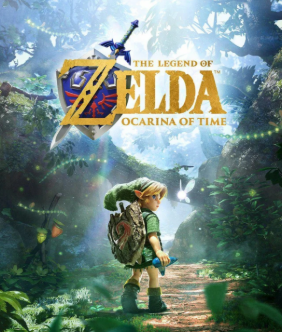
On June 9th, Nintendo announced a remake of the beloved classic The Legend of Zelda: Ocarina of Time for the Nintendo Switch 2 in honor of the series' 40th anniversary, which will release on November 5th. However, as with any remake, fans of the original are polarized. Nintendo announced the remake at the end of their Nintendo Direct, a showcase where they announced upcoming games and other projects. The announcement video was a little over a minute with very little footage of the actual game, instead serving mostly as an announcement that the game was happening. Later, on September 8th, Nintendo released a full trailer as well as a 20-minute showcase of the new features, which can be viewed either on YouTube or on Nintendo’s website. However, with the vast number of new details on the upcoming game, the fanbase has been divided. I'm here to see what Flagstaff High School’s population thinks of it.
Ocarina of Time was originally released on November 21st, 1998 for the Nintendo 64. It was one of the first fully 3D games, and it redefined what people thought games could be like. It is still, to this day, considered to be one of the greatest games of all time, proven by its 99/100 score on Metacritic.com, the highest score on the site. So regardless of what Nintendo did, a lot of people were going to be upset with any changes to the game. The main point of contention is the graphics, with people online saying that it looks too realistic or that it looks AI-generated, while people on the other side of the argument say that it looks exactly like how they imagined it looking as a kid.
A large reason that people don’t like the look is the high-resolution textures—going from the very simple visuals of the 1998 release to this modern interpretation where everything is very detailed. The models also look a bit strange, not really looking human. Previous developer of the N64 era games Takaya Imamura wrote about the designs online: “What I felt upon seeing this model is... I feel like Miyamoto-san's ‘love for puppet theater’ is firmly reflected here too!” Takaya shared that the models seem to resemble Japanese marionette figures known as Ningyogeki. Upon looking at the designs, it’s hard not to see the resemblance to the dolls, and that seems to be a pattern Nintendo has been following with Zelda. With Nintendo's previous Zelda remake for Link’s Awakening and the most recent installment in the franchise, Echoes of Wisdom, they also went down a path of making the characters resemble toys. With this new remake, they appear to be creating a toy-box aesthetic, with different characters looking like they're made of different materials.
I wanted to get an idea of the general opinions of those who attend this school. However, I wanted to make sure that the people I was interviewing at least had some knowledge on the subject. Firstly, I interviewed English teacher Alexander Casady. I specifically chose this teacher because we have already had conversations on this subject: “Typically, I like my remakes to reinvent or reimagine parts of the game, especially for games that have not aged as well, and I think for Ocarina of Time that game's gameplay has aged well so the only place you could update it would be the visuals. I think the visuals look bad. I think the visuals look terrible—I think the visuals look like Unreal Engine assets.”
The divisiveness of this remake is something that has echoed throughout the Zelda series for most of its history. Whenever a new Zelda art style is shown, there is always a large division among fans. This has been dubbed in the community as "The Zelda Cycle." The idea of the cycle is that whenever a new Zelda game is released, people dislike it, but once the next game is released, people go back to the previous entry and look upon it with praise despite being intensely negative previously. An example of this was with the 2002 release of The Wind Waker, which had a very distinct cel-shaded style. Upon announcement, it was flamed online for being too cartoony or not realistic enough. Later in 2006, when the next installment, Twilight Princess, released—which was the most realistic-looking game the franchise had been up to that point—it was criticized upon release for not looking as good as Wind Waker. Ultimately, we will see how the remake of one of the series’ most iconic games will be looked back upon when the next game releases.