
The Talon
Vol. 1 | Ed. 16
Shrinking Navy
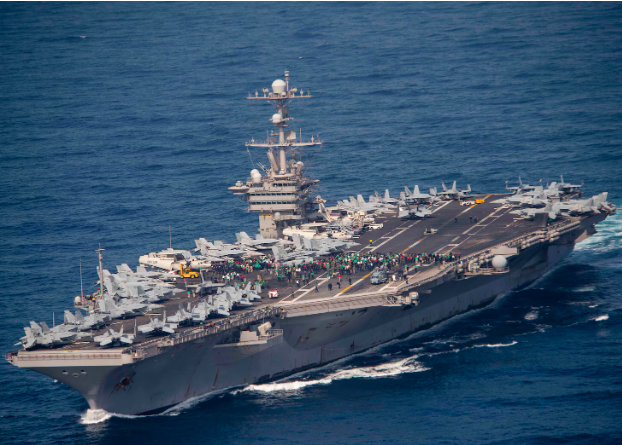
In the year 1987, the United States Navy was undeniably the strongest in the world, boasting a total of 594 naval vessels under its wide-reaching command. In the modern day, we are left with just a third of that number. Our naval presence is required in so many locations throughout the world to protect our interests, and this simply is not enough; we are stretched thin. What could have possibly atrophied the US Navy to this degree? Probably that we simply can’t make them anymore. The infrastructure needed to produce the watercraft we used to in the quantity we used to build is just not there anymore. Maybe in the ‘90s this wouldn’t have been an issue, but with the modern geopolitical state of the world, it is a necessity.
The USS John C. Stennis, a Nimitz-class nuclear-powered supercarrier (one of only 11 owned by the US Navy), entered dry docks for a refueling and complex overhaul in 2021 that was supposed to take three years to complete. It is still in the shipyards as of the writing of this article. There are many stories like this one plaguing the US Navy. When you take into consideration the months-long process of getting a crew and vessel ready to deploy, it becomes obvious how you could end up with situations like the USS Abraham Lincoln being at sea for 208 days straight or the USS George Washington being pulled out of the Indo-Pacific Theatre to deal with Iran, leaving that entire section of the world rife with geopolitical enemies without our naval presence.
The population of the US seems to be unaware of any of these issues. According to a United States Naval Institute 2020 article, the Navy has maintained a 78 to 84 percent approval rating since 2009, despite any and all issues with the Navy over the years, this has not changed. I interviewed several local students at Flagstaff High School to see what they thought of the Navy. 70% of people said that they thought the USA was the dominant naval force in the world; 30% of people said that China was. One outlier claimed that Great Britain was at the forefront of naval power, but they were most likely confusing their centuries and were not included. Only a third of everyone I spoke to had heard anything negative about the US Navy recently. The average confidence that people had in US naval projection on a scale of 1–10 was an 8.
When faced with the brutal truth of our Navy, one must ask, “What could have possibly led to this?” In 1981, the commercial shipbuilding subsidies that had been in effect since 1951 expired and were never renewed. This decimated the commercial shipbuilding industry in the US that kept the large shipyards necessary to produce large battleships afloat in between their military contracts. These effects were immediately felt over the course of the next 20 years. From 1987 to 1992, US shipyards sold 8 commercial ships over 1,000 tons; they sold 77 in 1975 alone. The issue has only compounded as more time passes. In 1987, the number of US shipyards that could build major combat ships was 55; in 2026, there are only 7.
Production is not the only issue facing the Navy at the moment, but rather resembles the body of a hydra that continues to sprout new heads daily. The sailors are being overworked and deployed for lengths of time that are outrageous for “peacetime,” causing massive unrest. The many examples of sailors aboard the USS Abraham Lincoln attempting to jump off the sides of the ship show this better than anything. Any and all changes made by the higher-ups seem to add months upon months on top of the time it takes to produce new vessels, which seems to be only worsened by the current administration’s ideas of aesthetic over functionality. This is blatantly obvious in the ideas of moving the island, the central command tower on aircraft carriers, from the back to the center to mimic the look of WW2 aircraft carriers. They were moved from the center to the back to improve efficiency of takeoffs and allow easier landings, all of which will be lost with the repositioning.